Two Visions, One Continent
Eduardo Brettas and Michael DiGiorgio built their careers in different regions of the Americas, within the same tradition of bird painting. Both work from direct observation of nature, with ornithological rigor, and both have made watercolor their medium.
In the book, these two perspectives complement each other and reveal the diversity of the birdlife, from the tropical forests of the south to the tundra of the far north.
A Brazilian Tradition of Neotropical Bird Painting
Fieldwork, Color, and a Naturalist's Eye
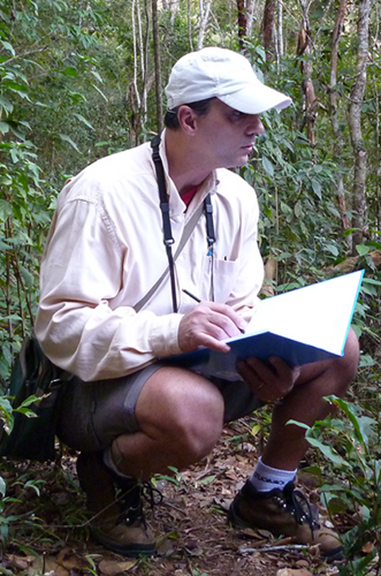
Eduardo Parentoni Brettas is a Brazilian naturalist painter and ornithological illustrator whose career has been built around the birds of South America. His work is born of field observation, museum study, and long collaboration with ornithologists. Over decades he developed a precise and recognizable language, marked by attention to structure, plumage, posture, behavior, and the character of each species.
His path was formed in close contact with Brazilian ornithology. Collaborations with Lenir Alda do Rosário, Herculano Alvarenga, Luís Fábio Silveira, and other researchers brought his painting close to the scientific process itself, in which understanding the bird is an essential part of representing it.
One of the central projects of his career was Toucans of the Americas, developed with the paleornithologist Herculano Alvarenga. Between 1997 and 2004, Brettas produced 44 original watercolor plates, covering the diversity of toucans, aracaris, and toucanets known at the time. Published in 2004, the book consolidated a broad pictorial record of the family Ramphastidae and became a landmark in his production.
His collaboration with Dr. Luís Fábio Silveira gave rise to other important work. In Terra Papagalli, he turned to the parrots, macaws, parakeets, and related species of Brazil. In Beija-flores do Brasil, he faced the challenge of recording subtle differences of form, color, and iridescence, preserving at once scientific accuracy and a sense of movement and life.
Brettas also took part in large field-guide projects, among them Aves da Amazônia Brasileira, covering more than a thousand species from the region. Work of this scale demands consistency, comparative accuracy, and command of the plumage variations needed both for research and for field observation.
His work continues on an international scale. Brettas collaborates with the American ornithologist Kevin Zimmer on a new Birds of Brazil project for Princeton University Press, including a volume devoted to the Pantanal and the Cerrado.
For Winged Jewels of the Americas, Brettas brought to the collection decades of experience with Neotropical birdlife. His contribution concentrates mainly on the birds of South and Central America and holds to the principles that guide his path: direct observation, scientific consultation, careful drawing, and constant attention to the living bird.
From Toucans of the Americas to Terra Papagalli, from Beija-flores do Brasil to the major field guides and, now, to Winged Jewels of the Americas, Brettas has built a broad visual record of Neotropical birdlife.
The birds are painted with scientific rigor, from observation.
A Living Lineage of North American Bird Painting
Nature Observed with Precision and Sensibility
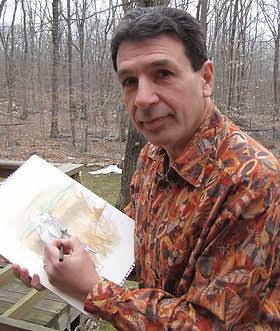
Michael DiGiorgio is an American bird painter and illustrator based in Madison, Connecticut. His work is born of direct observation: field sketches, studies of posture and behavior, anatomical notes, museum specimens, and years spent alongside birds. His paintings are recognized for their accuracy, the naturalness of their postures, and their ability to preserve the presence of the living bird.
Over his career he has traveled widely through North America, the Caribbean, and South America, studying birds and their habitats. His illustrations have appeared in major ornithological publications, among them the Peterson Field Guide to Birds of North America, the Wildlife Conservation Society Birds of Brazil series, Guide to the Birds of Honduras, Audubon Magazine, and The Narrow Edge. He also worked with Robert Ridgely and Guy Tudor on important projects on South American birds.
Don Eckelberry played a decisive part in his formation, encouraging him to draw living birds, to remain in the field, and to understand each species before representing it. In 2005, DiGiorgio became the first recipient of the Eckelberry Endowment, established in the artist's memory by the Academy of Natural Sciences in Philadelphia.
Museum study also holds an important place in his method. Access to ornithological collections, such as that of the Peabody Museum at Yale University, allowed him to compare plumages, study specimens, and confirm details difficult to resolve in the field alone. This combination of direct observation and collection study gives his illustrations depth and reliability.
For Winged Jewels of the Americas, DiGiorgio was recommended by Albert Earl Gilbert, who recognized in his work a natural continuation of the North American tradition of bird painting. In the collection, he painted mainly species from North America, along with selected birds from Central and South America.
His contribution brings together precise drawing, knowledge of anatomy and behavior, and sensitivity to the character of each species. His paintings have clarity enough for the ornithologist's eye and force enough to stand as independent works of art.
Beyond birds, DiGiorgio has also taken part in scientific reconstructions. In 2010, he produced a full-color reconstruction of Anchiornis huxleyi, associated with research published in the journal Science.
DiGiorgio continues to teach, paint, and work in conservation. His own words well sum up the purpose of his work:
“My greatest hope is that my work inspires people to become bird watchers and to want to go out and save them.”
For Winged Jewels of the Americas, this combination of observation, knowledge, and artistic discipline made Michael DiGiorgio an essential presence in the collection.